Can AI Build SaaS Products? What Founders Need to Know
 By snapblockaiMay 27, 2026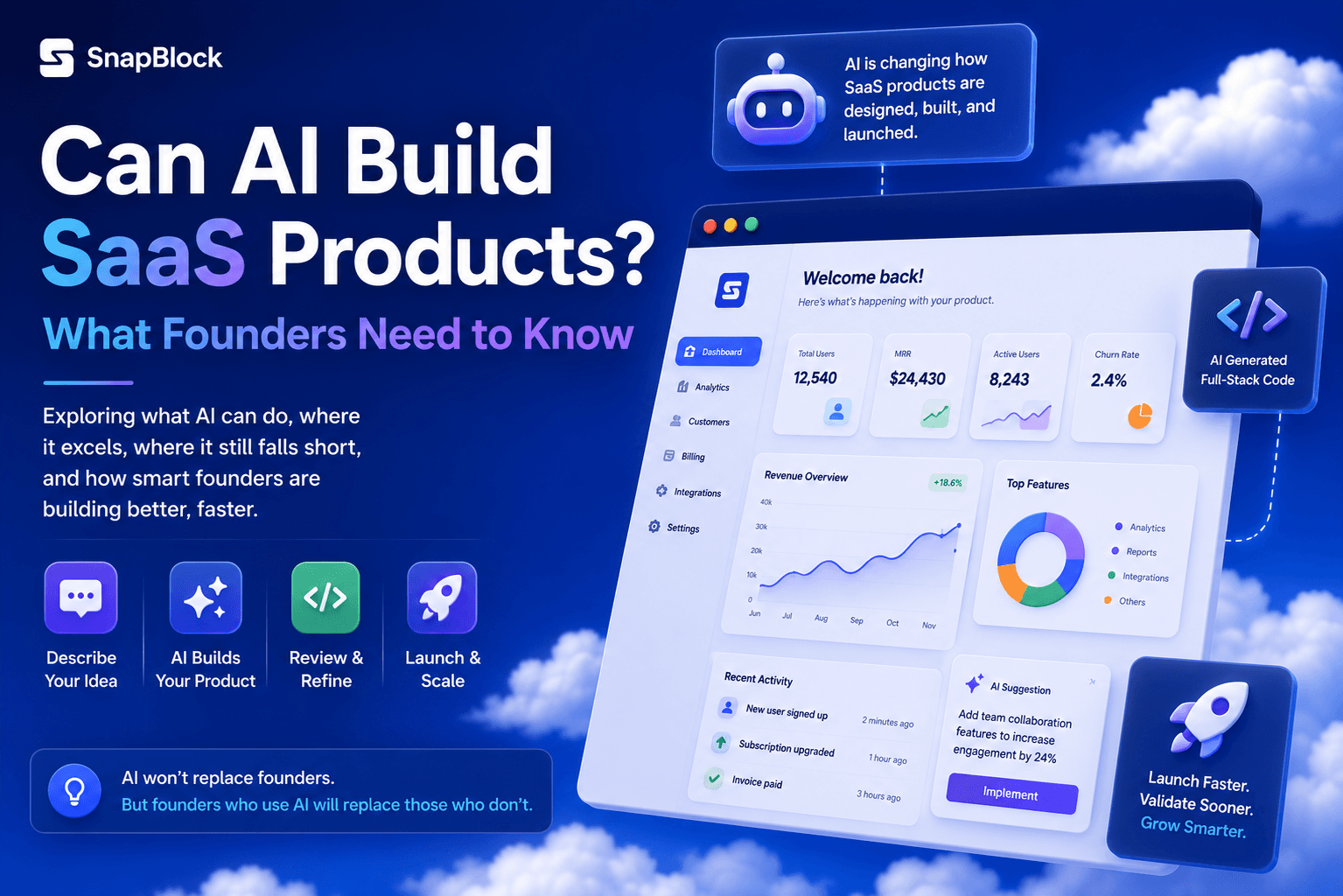
A few years ago, asking whether artificial intelligence could build software products would have sounded unrealistic.
Today, founders are launching startup websites, generating interfaces, creating dashboards, automating workflows, and building MVPs with AI-assisted tools faster than traditional development cycles previously allowed.
The question is no longer whether AI can contribute to software creation.
The real question has become far more interesting:
Can AI actually build SaaS products?
The answer depends on how people define “build.”
Artificial intelligence is already changing how software gets designed, structured, tested, and launched. But the shift happening underneath the surface is larger than automation alone.
Software creation itself is becoming more conversational.
Founders increasingly describe products instead of manually assembling every layer from scratch.
That transition is reshaping startup execution entirely.
Why SaaS Development Traditionally Took So Long
Building software products historically required coordination across multiple disciplines.
Design teams created interfaces.
Frontend developers translated designs into usable experiences.
Backend engineers managed databases, authentication, APIs, and infrastructure.
Deployment introduced another layer entirely.
Even relatively small products could take months before users interacted with the first usable version.
For startups, that created pressure.
Founders often spent significant resources building before validating whether customers actually wanted the product.
Teams hired earlier than necessary.
Operational complexity arrived early.
Launch timelines stretched.
The traditional workflow worked, but it introduced friction that slowed learning.
And for startups, slower learning often means slower growth.
AI Is Changing the Starting Point of Product Development
One of the biggest changes introduced by AI is not technical.
It is behavioral.
Historically, software creation started with implementation.
Builders thought about frameworks, layouts, databases, infrastructure, and engineering workflows before products became usable.
Artificial intelligence changes that sequence.
Founders increasingly begin with intent.
Describe the product.
Explain the workflow.
Define the experience.
The AI helps generate foundations that previously required multiple stages of manual work.
A founder may request:
“Build a SaaS platform for appointment scheduling with authentication, subscriptions, analytics, and responsive design.”
The system generates product structure.
Interfaces.
Layouts.
User flows.
Foundational logic.
What once required extensive setup increasingly begins through conversation.
That shift explains why AI product creation is gaining attention so quickly.
What AI Can Already Do Well
Artificial intelligence is already capable of accelerating several parts of SaaS development.
AI systems can generate landing pages, dashboards, onboarding flows, interface structures, and design systems with impressive speed. Many platforms can also assist with frontend code generation, content structure, responsiveness, and workflow automation.
For early-stage founders, this creates enormous advantages.
Instead of spending weeks building basic product foundations manually, startups can move into testing and iteration significantly faster.
That speed matters because early-stage companies rarely fail due to lack of ideas.
More often, they fail because execution moves too slowly.
Platforms like SnapBlock reflect this larger transition by helping founders create websites and production-ready digital experiences through conversational AI workflows rather than relying entirely on traditional software development processes.
The technology reduces operational friction during the earliest and often most fragile stages of startup building.
What AI Still Struggles With
Despite rapid progress, artificial intelligence still has limitations.
Complex enterprise systems often require architectural decisions that go beyond automated generation. Security-sensitive environments still benefit heavily from experienced engineering oversight. Highly customized backend systems frequently require deeper technical implementation.
AI can accelerate software creation dramatically.
That does not automatically mean it replaces experienced developers entirely.
Strong software products still require judgment.
Product thinking still matters.
Scalability decisions still matter.
Customer understanding still matters.
The most effective founders are not using AI to avoid thinking.
They are using AI to remove repetitive operational bottlenecks.
That distinction matters more than most people realize.
Why Founders Are Adopting AI Product Builders
The startup environment has changed significantly.
Founders today operate in markets where speed influences survival.
Customer expectations evolve quickly.
Competitors launch quickly.
Product iteration cycles move faster than ever.
AI product builders align naturally with this environment because they reduce the time between concept and execution.
Instead of spending months preparing for launch, founders can test ideas earlier.
Landing pages go live faster.
MVPs become usable sooner.
Feedback loops improve.
This creates stronger learning cycles.
And stronger learning cycles often outperform perfect planning.
That is one of the biggest reasons AI-assisted product development continues growing rapidly among startup teams.
AI Is Not Replacing Founders or Developers
One misconception surrounding AI product development is the belief that software creation will become completely automated.
That is unlikely.
Technology changes execution layers.
It does not eliminate strategic thinking.
The strongest products still require customer insight, positioning, product direction, operational judgment, and long-term decision-making.
Artificial intelligence improves leverage.
It accelerates workflows.
It removes repetitive implementation work.
But founders still define vision.
Developers still solve complex problems.
The companies gaining the most value from AI today are combining human judgment with systems that improve execution speed.
That balance is where the real advantage exists.
The Future of SaaS Development May Be Conversational
Perhaps the biggest long-term shift happening underneath AI software generation is that software creation itself is becoming more accessible.
The interface increasingly becomes language.
Describe what you want.
Refine it naturally.
Improve the product collaboratively.
That pattern is already reshaping content creation, research, automation, and software building.
SaaS development appears to be moving in the same direction.
Founders who adapt early may gain significant advantages over the coming years because operational speed compounds.
Especially in startups.
Final Thoughts
Can AI build SaaS products?
Increasingly, yes — at least partially.
Artificial intelligence is already capable of generating foundational product experiences, accelerating development workflows, and helping founders move from ideas to execution much faster than traditional startup models previously allowed.
But the larger opportunity is not replacing people.
It is reducing friction.
The future of software development likely combines AI acceleration with human strategy, creativity, and technical judgment.
For founders building in 2026 and beyond, understanding how to use AI effectively may become just as important as understanding how to build products themselves.